BRIEF
INTRODUCTION TO PLASMODIUMS (Rev. Dec 17, 2025)
A plasmodium is a protozoa intra-cellular parasite that is
normally carried by the Anopheles mosquito. Once a human is bitten
by an infected mosquito, the plasmodiums (in their sporozoites
morphological state) travel to the liver, where they invade some
of the liver cells in order to make merozoites (another
morphological state of plasmodiums). The merozoites travel in the
blood and penetrate RBCs (Red Blood Cells). Inside the RBCs, the
plasmodium makes copies of itself, and depending on the species of
the plasmodium, a certain number of merozoites are made inside
each infected RBC.
There are 200 species of plasmodiums. Less than 2 decades ago,
medical science believed that only 4 species of plasmodiums
were capable of infecting humans. However, about 15 years ago, in
New York, they discovered that a woman was infected with one of
the simian plasmodiums, previously believed to infect only simians
(apes, monkeys). Therefore, they added that plasmodium species (P.
Knowlesis) to the other four plasmodiums known to infect humans;
P. Falciparum, P. Ovale, P. Vivax, and P. Malarie. These 5
plasmodium species can cause the disease named Malaria.
However, I believe that there are other plasmodium
species that are capable of infecting humans, and might not cause
the typical Malaria symptoms. Instead, these other plasmodiums can
cause symptoms similar to COPD (Chronic Obstructive Pulmonary
Disease) and/or CFD (Chronic Fatigue Syndrome) and/or IBS-D
(Irritable Bowel Syndrome - Diarrhea), and/or IBD (Inflammatory
Bowel Disease).
Plasmodium infected RBCs are not capable of performing their
normal function. And when they burst open, to release the
merozoites, they increase the amount of biliverde in the blood.
The biliverde is converted to bilirubin. The liver might not be
able to process the excess bilirubin, and might dump (into the
intestine) some unconjugated bilirubin (oil
soluble) instead of the normally conjugated bilirubin
(water soluble). This will cause bright yellow diarrhea or yellow
soft-feces, because the intestinal bacteria can only oxidize
conjugated bilirubin (turning it brown).
Depending on the number of RBCs that are infected, the infected
person might feel a shortness of breath, and fatigue. Symptoms
similar to anemia, not because of low RBC count, but because a
certain percentage of the circulating RBCs can not perform their
normal function.
FINDING PLASMODIUMS IN THE BLOOD
Finding plasmodiums in the blood is not difficult, if you have
a microscope and know what to look for. Also, you should use
capillary blood (from a finger tip) as recommended
by the CDC (Center for Disease Control) and NOT
peripheral blood from an arm vein, as erroneously done by the VA
healthcare system and many laboratories.
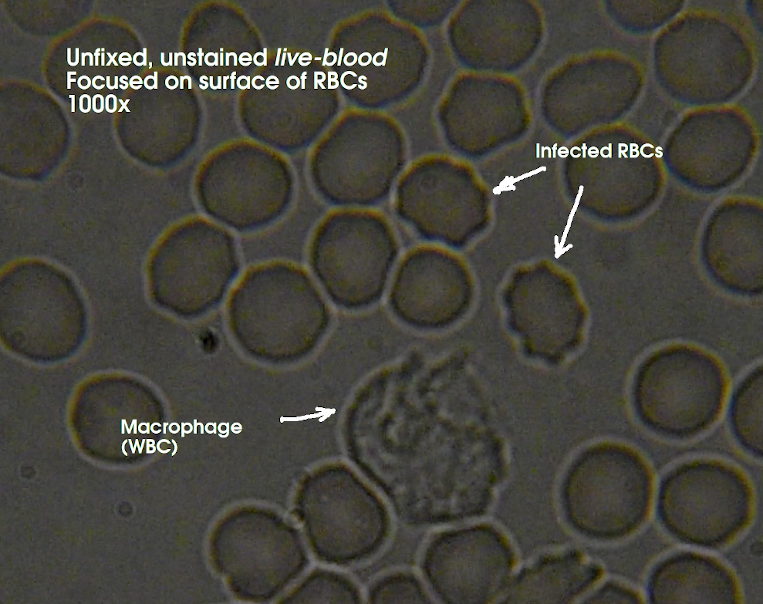
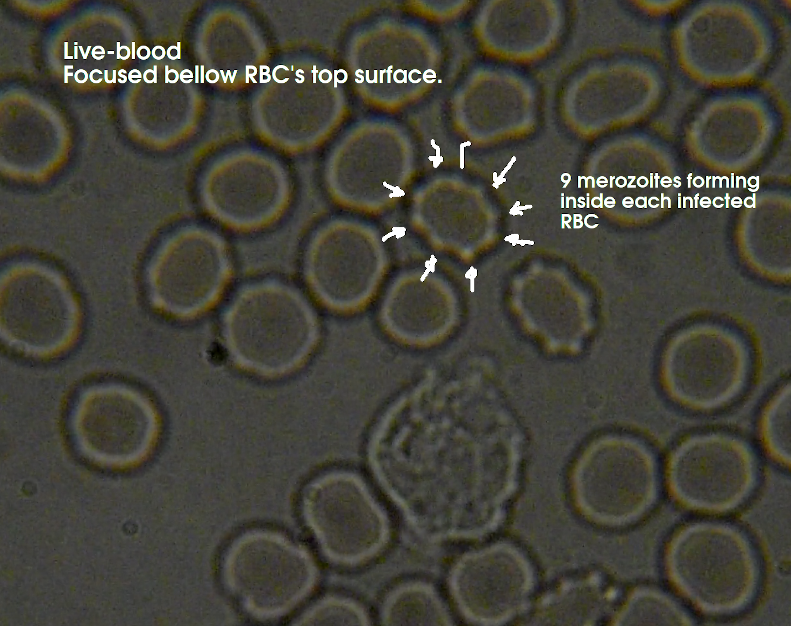
One simple method, that I found accidentally, is to make a
microscope slide using capillary "live-blood" from a finger
tip. Live -blood is a term I use to describe blood that
has not been fixed with alcohol nor has it
been stained. If we place a tiny drop of
live-blood on a microscope slide and immediately cover it with a
slide cover glass. Then place the slide in the microscope, set
1000x magnification, and then look at the RBCs. First focus on the
top surface of the RBCs, then slowly adjust the focus to look
bellow the surface of the RBCs, to see if there are any merozoites
being formed inside of the RBCs, see examples bellow:

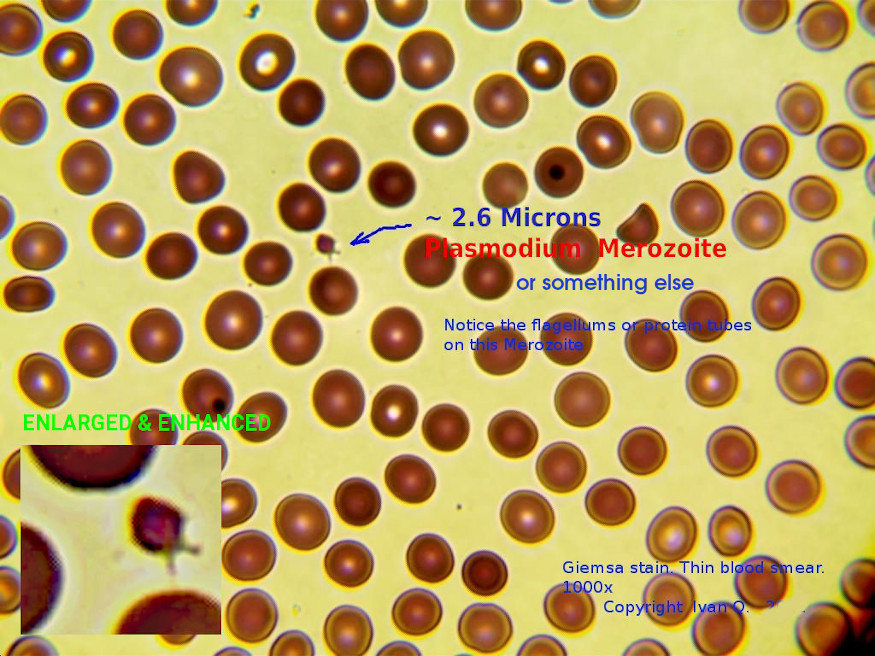
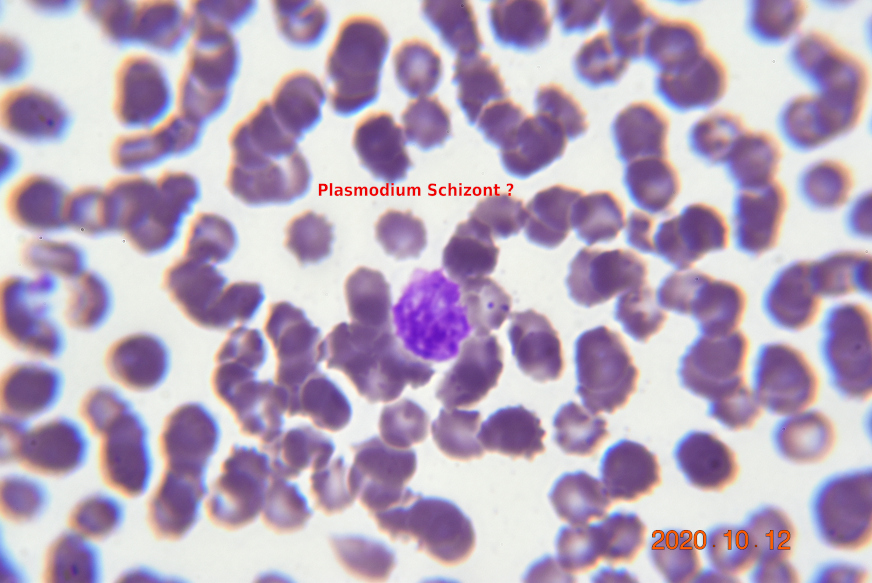
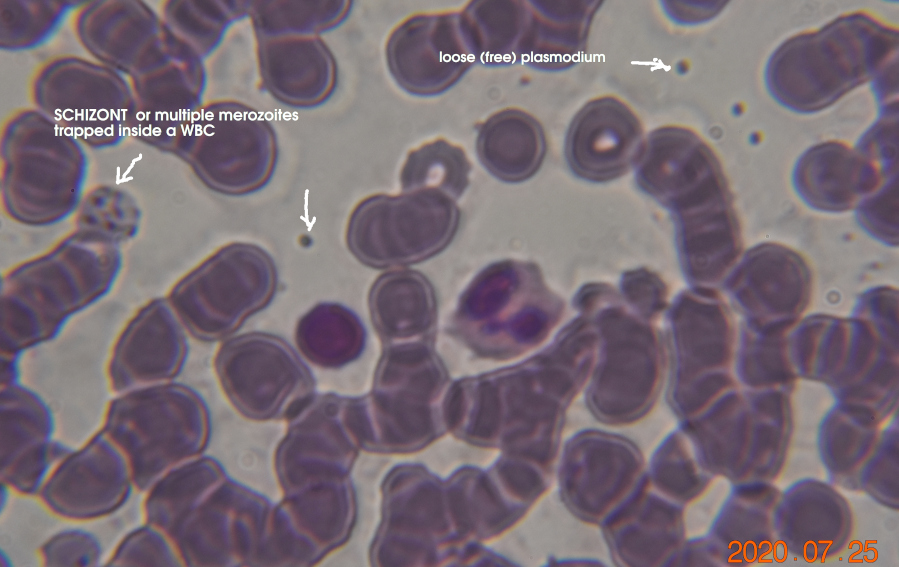
If the blood is fixed and stained, then
depending on the methodology used to fix and stain the slides, and
the type of stain used, we can identify plasmodiums or other types
of blood pathogens. See examples bellow:
Some micrographs were captured with a simple microscope digital
camera, other were captured with a 24 Megapixels Nikon Digital
camera. Therefore some micrographs were cropped or shrunk to
better fit this web page.


REFERENCES:
CLINICAL MICROBIOLOGY made
ridiculously simple. (6th Edition) (pg 343)
Paniker's Textbook of MEDICAL PARASITOLOGY (8th
Edition)
MEDICAL PARASITOLOGY A Self-Instructional Text (7th Edition)
https://en.wikipedia.org/wiki/Malaria
https://en.wikipedia.org/wiki/Plasmodium
RETURN